96 minutes into Matthew Akers’ 105 minute documentary
Marina Abramović: The
Artist is Present, a young woman walks up to the chair placed across from a
perfectly still, seated Marina Abramović, slides out of her dress and is
quickly rushed away by security. She had been waiting, like many others, for
hours – possibly days – to sit across from the “grandmother of performance
art.” A few minutes before this scene, she even calls the act of waiting to sit
across from Abramović “kind of a [performance] piece in itself – dedicating
this much commitment to her.” Abramović has apparently had a huge influence on
her work, and the younger artist “just wanted to be as vulnerable to her as she
makes herself to everyone else.”
Marina Abramović: The Artist is Present follows Abramović as she
prepares for her 2010 performance retrospective of the same name at the Museum
of Modern Art in New York. The show includes video documentation of
performances, both solo and with her long-time former collaborator and partner,
Ulay; artifacts like the set up for
Rhythm 0 (1974), where 72 objects
(including a gun and bullet) where placed on a table for the audience to use on
her; reenactments of pieces by a hand-selected group of performers; and a new
piece in which, for the duration of the show, she silently sits across from
members of the public. At first this is done with a table between the two
seated bodies, much like
Nightsea Crossing (1981-7), originally
performed with Ulay, but eventually the table is taken away, leaving her more
vulnerabie to whatever the person sitting across from her might do, as noted by
Tunji Adewiji, Director of Safety at MoMA, who seems to be personally
overseeing Abramović’s security.
Probably the most difficult to look at photo of Rhythm 0
(1974)
As stated and re-stated, Abramović is no stranger to giving much of herself to her
work, to her audience, and to performance art as a whole, sometimes even
putting her body in extreme danger. In
Rhythm 0, her shirt was ripped
off and a rose attached to her chest via its thorns. Despite a signed document
claiming herself as the only accountable party if anything should happen, the
performance was cut short when the cops were called because a loaded gun was
put in her hand, pointed towards her head. Her work with Ulay involved acts
such as spinning until neither could get up anymore, balancing a taut bow
between the two of them with an arrow pointed at her heart, and in their final
piece, walking the length of the Great Wall of China until they met in the
middle, ending their personal and artistic twelve year relationship. She has
spilled her own blood and endured extreme, self-inflicted tests of physical and
mental strength.
Now, at 63, she is sitting as still as possible for 7 hours a day, 6 days a week,
for 3 months. In describing just how she is able to sit so still for so long,
she states “The moment you really go through the door of pain, you enter to
another state of mind, this feeling of beauty and unconditional love. You start
having this incredible feeling of lightness.” While it is no question that her
endurance pieces require immense mental and physical strength, Akers really
focuses on the strength she receives from the audience. Klaus Beisenbach, Chief
Curator at Large at MoMA and Abramović’s ex-husband, says “she needs the
audience like air to breathe.” He recounts feeling so loved by her at the
beginning of their relationship only to realize that what she really loves is
the entire world, not just him.

Abramović stretching after a day of sitting. I really loved these moments - her verbalization of the pain, the things she must do to continue on with the performance, the fact that there's a secret compartment in the chair for her to pee in.
In many ways, this performance takes the idea of being in love with the entire
world, or at least with her audience, almost literally; after all, it was
clearly developed from
Nightsea Crossing, a piece famously performed and
re-performed with Ulay. Instead of her partner sitting across from her, the
audience is. They don’t get 19 straight days across from her, but they do get a
few moments, in between her eyes closing for what seems like a reset, where
they stare at her and she stares at them. She describes being a mirror for
whomever is seated across her. Sometimes smiles are shared,
sometimes tears.
She would indeed literally be no one without those who come to see her and her
work, two things inherently fused, and in the thousands of individual moments
that comprise this piece, she sees them.
I couldn't find images of the queue, but this screen shot from Pippin Barr's video game The Artist is Present is nothing in comparison.
Once she decides to take away the table separating her from her audience, Beisenbach
simply comments “The priest doesn’t need the cross.” While I think she’s maybe
more of a god/profit/priest hybrid if that’s the analogy you’re going for with
Abramović, this statement pretty succintly sums up the one aspect of her work I
wish Akers had explored more, if at all: just how, for better or worse, it has
changed. Abramović repeats throughout the documentary that she wants not only
her work but the whole of performance art to be mainstream. (I was actually
pretty amazed, in discussing this documentary with others, just how many people
have little to no idea who she is.) She’s devoted over 40 years to both her own
work and the training of future performance artists, a process we get to
witness when the 30 performers used in her retrospective partake in a
“performance art boot camp” at her upstate New York estate. She’s been called
crazy by many, the validity of her work has been questioned over and over again
(and continues to be, as shown by clips of a few local newscasters shouting
¡Escándalo!...though I mean it’s not like they have art history degrees or anything. Not that only people with degrees can enjoy art, but still.), despite influencing and being adored by millions.
Whatever Abramović had the performers do is, as you would imagine, way more difficult than it looks (yet still retains a lot of the beauty of her work?). Read an amazing account of it by Brittany Bailey in Gnome Magazine.
She’s given a lot of herself and worked really hard to get to the place that she is,
but she just isn’t the young woman who stood naked across from a naked Ulay
while men fondled her as they slid past the two bodies to get into a gallery.
She would never perform
Rhythm 0 again. She’s an art rockstar, she’s in
her 60s, and her performances now require a security team that responds to
signs from Abramović to take away anyone who makes her uncomfortable. She’s not
completely unvulnerable, but she’s puh-retty close to it.
Akers’ documentary does way more than just depict how
Marina Abramovic: The Artist
is Present was made; it includes stories of her childhood, her relationship
with Ulay (who she is reunited with for the first time since they broke up,
like, 20+ years prior), documentation of a lot of her work, her search for
love. She’s incredibly charming, and when she talks about getting her nails did
and buying her first designer clothing after breaking up with Ulay, a
relationship during which she lived in a van in order to continue making work,
all I wanted to do was rejoice in her success. She works and has worked so
hard, she’s endured so much, she
deserves the money, the fame, the
legitimacy. Plus OMG her awkward laugh. It’s really hard not to root for her
and also understand that, duh, she needs to be protected. There are crazies out
there and a shit ton of people waited hella long to silently sit across from
her. (I’m trying to think of a way to fashion Abramović’s name into something
akin to Bebliever. Suggestions?)
If you survive the scene where Ulay sits across from her without crying, you have no soul.
But then there’s this moment when a young performance artist walks up to her, takes
off her dress, and is quickly whisked away. The crowd boos. She is interviewed
as she waits to possibly get another chance at sitting across from Abramović,
and apparently she “thought in that space, in that square, ... the audience is,
like, part of the art and what you bring to it,” which is basically what we,
the viewers of the documentary, were made to believe. Plus, I mean, the fact
that she was removed for getting naked in front of Marina Abramović is sort of
laughable. Not only are there videos and photos Abramović naked all up in that
show, there are also actual naked people. So much nudity.
Srsly though.
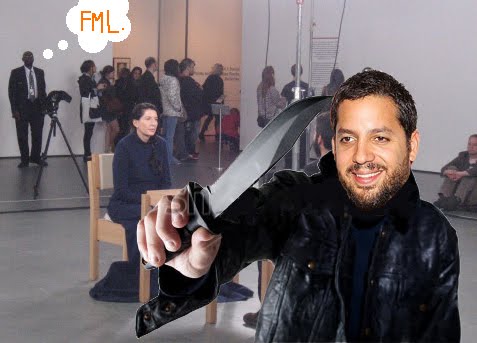
In a cameo way less annoying than James Franco’s but still sort of strange, David
Blaine eats some glass with his wine in Abramović’s apartment and suggests an
intervention of her performance in which he very publicly and very gruesomely
kills her. When she presents this idea to her gallerist, Sean Kelly, he makes a
face and is all like “He’s an illusionist. Your work doesn’t have anything to
do with illusion;
it’s all real.” (Last aside, I swear: Her actually
bringing this up to her gallerist was one of my favorite parts; as someone
who’s worked as an assistant to many artists, I was giddy at the fact that
Akers showed that even the best artists have god awful ideas.)
While I definitely think this documentary is really entertaining and serves as an
important record of Abramović’s work, life & practice, it leaves a pretty
unsettling feeling in the pit of my stomach, particularly as someone who works
in performance. While we are being told by MoMA security, by critics, by those
who go to see her, even by herself that she is incredibly vulnerable during
The Artist is Present and so much of the focus is on the audience, this naked woman being taken away in tears shows that those statements are just no longer true. It
isn’t “all real,” especially if real is talking about this piece
with the same language as her older work. Given her age and fame, she will
never be able to make the same type of work that she used to, and I mean,
that’s fine. It’s really amazing and impressive that she’s still producing, let
alone such physically arduous work. I just wonder, with all of her lamentations
of being underground for so long, of being called crazy, if this is the price
performance art will have to pay for going mainstream. I honestly don’t think
that most of it will at all ever, and while it sucks to realize there’s a part
of you that’s ok with never having any sort of financial stability via what you
love to do, I’m pretty chill with that.