Wednesday, January 9, 2013

AWKWARD INTIMACIES: SOME NOTES ON MY WORK


Yo, MCs better start chatting about what's really happening
Because if you ain't chatting about what's happening
Where you living? What you talking about?
                                                - Dizzee Rascal, “Brand New Day,” Boy in da Corner

While I don’t know that I would necessarily apply the bravado of Mr. Rascal’s lyrics to my own work, this quote popped into my head recently upon realizing that dialectical materialism is sort of Marx (& crew)’s “real talk” moment. That led me to the importance of naming, of “chatting about what’s really happening,” but also chatting about what has happened, which is more precisely where my work fits into this equation.

The way that I consider the past from the standpoint of the present can best be understood through “hauntology,” a term used by Jacques Derrida in his Spectres of Marx. This idea, this word, is a no-brainer to the type of person I embody - female, Mexican-American, a victim of sexual and physical violence, someone who is stared at or commented on for reasons ranging from my tendency to wear black to my large ass. The space I inhabit, particularly in public, is constantly being considered as a potential past, current, or future site of trauma. Also inherent in traversing public space, particularly urban public space, for someone who occupies a body, existence, and/or mindset of an “other” is the very real presence of the lack of my history, of the places and memories important to me that will be torn down or forgotten without remorse or even a measly gold plaque. The (big A) Archive, as it turns out, is just another MC not “chatting about what’s really happening” or what really has happened to a significant number of people.

It is within these hidden histories of spaces and the people who use them that I literally and figuratively produce work. My process is research-heavy and interdisciplinary (mostly because I’m a massive nerd). It certainly has strong ties to anthropological and experimental archaeological investigation, but the type of investigation I engage in does not end when the piece is performed or even after its documentation has been edited down to a 2 minute Quicktime file prepared for Internet streaming. Much of what excites me about performance as an art and as a means of research is its potential for embodied transmission of knowledge and memory, an idea I discovered a language for in Diana Taylor’s The Archive and the Repertoire. So I tend to repeat specific actions in specific places for a specific amount of time to try to, I don’t know, utilize the liminal nature of durational work to get some sort of sense for the story or idea I encountered that led me to create something for and about it, which of course, means that the performance itself isn’t usually the end of the work. After falling in love with an idea and discovering something new about it, it’s difficult to relegate it to the existence of a spectre. Works literally create other works or I make works about old works or old ideas. Or I just change my mind. I have a lot of issues with framing anything.

Which then brings me to the idea of object agency in the materials and general aesthetic logics my work engages. One of the more important media I use is my body, which certainly is able to assert itself either over or in a different way than my brain. I feel like it’s pretty obvious that bodies have methods of learning and stored knowledge independent from the brain, otherwise a lot of things about being a human amongst other humans would be a lot easier. So the other media I use are just as banal and every day as one’s own body. I am actively lo-fi in my performance documentation, and in 2D work, I have most prominently used things like 8 ½ x 11 sheets of printer paper, used biore strips, partially-erased notebook pages, and accidental photographs. In How to Make an Art, Jayson Musson, as his alter-ego Hennessey Youngman, advises the Internet “Make sure you say [your art is] exploring something or challenging or investigating, but don’t say it’s solving anything, all right?” Though Musson is clearly using the character of Youngman as a means for institutional critique, this is very essentially how I feel about a lot of my work. Real talk. The agency of the objects I use exists in that they aren’t elevated above what they are. They’re simple, small, and a little bit boring, but I sort of like that. In trying to “[chat] about what’s really happening,” using the aesthetic of the everyday makes sense, I think. I also generally don’t respond too well to the big, bright, glossy stuff.

Monday, August 13, 2012

IT'S SORT OF LIKE WHEN YOU REALIZE YOUR PARENTS ARE JUST HUMAN, TOO: MY RESPONSE TO THE MARINA ABRAMOVIĆ DOCUMENTARY


96 minutes into Matthew Akers’ 105 minute documentary Marina Abramović: The Artist is Present, a young woman walks up to the chair placed across from a perfectly still, seated Marina Abramović, slides out of her dress and is quickly rushed away by security. She had been waiting, like many others, for hours – possibly days – to sit across from the “grandmother of performance art.” A few minutes before this scene, she even calls the act of waiting to sit across from Abramović “kind of a [performance] piece in itself – dedicating this much commitment to her.” Abramović has apparently had a huge influence on her work, and the younger artist “just wanted to be as vulnerable to her as she makes herself to everyone else.”


Marina Abramović: The Artist is Present follows Abramović as she prepares for her 2010 performance retrospective of the same name at the Museum of Modern Art in New York. The show includes video documentation of performances, both solo and with her long-time former collaborator and partner, Ulay; artifacts like the set up for Rhythm 0 (1974), where 72 objects (including a gun and bullet) where placed on a table for the audience to use on her; reenactments of pieces by a hand-selected group of performers; and a new piece in which, for the duration of the show, she silently sits across from members of the public. At first this is done with a table between the two seated bodies, much like Nightsea Crossing (1981-7), originally performed with Ulay, but eventually the table is taken away, leaving her more vulnerabie to whatever the person sitting across from her might do, as noted by Tunji Adewiji, Director of Safety at MoMA, who seems to be personally overseeing Abramović’s security.

Probably the most difficult to look at photo of Rhythm 0 (1974)

As stated and re-stated, Abramović is no stranger to giving much of herself to her work, to her audience, and to performance art as a whole, sometimes even putting her body in extreme danger. In Rhythm 0, her shirt was ripped off and a rose attached to her chest via its thorns. Despite a signed document claiming herself as the only accountable party if anything should happen, the performance was cut short when the cops were called because a loaded gun was put in her hand, pointed towards her head. Her work with Ulay involved acts such as spinning until neither could get up anymore, balancing a taut bow between the two of them with an arrow pointed at her heart, and in their final piece, walking the length of the Great Wall of China until they met in the middle, ending their personal and artistic twelve year relationship. She has spilled her own blood and endured extreme, self-inflicted tests of physical and mental strength.

Now, at 63, she is sitting as still as possible for 7 hours a day, 6 days a week, for 3 months. In describing just how she is able to sit so still for so long, she states “The moment you really go through the door of pain, you enter to another state of mind, this feeling of beauty and unconditional love. You start having this incredible feeling of lightness.” While it is no question that her endurance pieces require immense mental and physical strength, Akers really focuses on the strength she receives from the audience. Klaus Beisenbach, Chief Curator at Large at MoMA and Abramović’s ex-husband, says “she needs the audience like air to breathe.” He recounts feeling so loved by her at the beginning of their relationship only to realize that what she really loves is the entire world, not just him.

Abramović stretching after a day of sitting. I really loved these moments - her verbalization of the pain, the things she must do to continue on with the performance, the fact that there's a secret compartment in the chair for her to pee in.

In many ways, this performance takes the idea of being in love with the entire world, or at least with her audience, almost literally; after all, it was clearly developed from Nightsea Crossing, a piece famously performed and re-performed with Ulay. Instead of her partner sitting across from her, the audience is. They don’t get 19 straight days across from her, but they do get a few moments, in between her eyes closing for what seems like a reset, where they stare at her and she stares at them. She describes being a mirror for whomever is seated across her. Sometimes smiles are shared, sometimes tears. She would indeed literally be no one without those who come to see her and her work, two things inherently fused, and in the thousands of individual moments that comprise this piece, she sees them.

I couldn't find images of the queue, but this screen shot from Pippin Barr's video game The Artist is Present is nothing in comparison.

Once she decides to take away the table separating her from her audience, Beisenbach simply comments “The priest doesn’t need the cross.” While I think she’s maybe more of a god/profit/priest hybrid if that’s the analogy you’re going for with Abramović, this statement pretty succintly sums up the one aspect of her work I wish Akers had explored more, if at all: just how, for better or worse, it has changed. Abramović repeats throughout the documentary that she wants not only her work but the whole of performance art to be mainstream. (I was actually pretty amazed, in discussing this documentary with others, just how many people have little to no idea who she is.) She’s devoted over 40 years to both her own work and the training of future performance artists, a process we get to witness when the 30 performers used in her retrospective partake in a “performance art boot camp” at her upstate New York estate. She’s been called crazy by many, the validity of her work has been questioned over and over again (and continues to be, as shown by clips of a few local newscasters shouting ¡Escándalo!...though I mean it’s not like they have art history degrees or anything. Not that only people with degrees can enjoy art, but still.), despite influencing and being adored by millions.

Whatever Abramović had the performers do is, as you would imagine, way more difficult than it looks (yet still retains a lot of the beauty of her work?). Read an amazing account of it by Brittany Bailey in Gnome Magazine.

She’s given a lot of herself and worked really hard to get to the place that she is, but she just isn’t the young woman who stood naked across from a naked Ulay while men fondled her as they slid past the two bodies to get into a gallery. She would never perform Rhythm 0 again. She’s an art rockstar, she’s in her 60s, and her performances now require a security team that responds to signs from Abramović to take away anyone who makes her uncomfortable. She’s not completely unvulnerable, but she’s puh-retty close to it.

Akers’ documentary does way more than just depict how Marina Abramovic: The Artist is Present was made; it includes stories of her childhood, her relationship with Ulay (who she is reunited with for the first time since they broke up, like, 20+ years prior), documentation of a lot of her work, her search for love. She’s incredibly charming, and when she talks about getting her nails did and buying her first designer clothing after breaking up with Ulay, a relationship during which she lived in a van in order to continue making work, all I wanted to do was rejoice in her success. She works and has worked so hard, she’s endured so much, she deserves the money, the fame, the legitimacy. Plus OMG her awkward laugh. It’s really hard not to root for her and also understand that, duh, she needs to be protected. There are crazies out there and a shit ton of people waited hella long to silently sit across from her. (I’m trying to think of a way to fashion Abramović’s name into something akin to Bebliever. Suggestions?)


If you survive the scene where Ulay sits across from her without crying, you have no soul.

But then there’s this moment when a young performance artist walks up to her, takes off her dress, and is quickly whisked away. The crowd boos. She is interviewed as she waits to possibly get another chance at sitting across from Abramović, and apparently she “thought in that space, in that square, ... the audience is, like, part of the art and what you bring to it,” which is basically what we, the viewers of the documentary, were made to believe. Plus, I mean, the fact that she was removed for getting naked in front of Marina Abramović is sort of laughable. Not only are there videos and photos Abramović naked all up in that show, there are also actual naked people. So much nudity.


Srsly though.

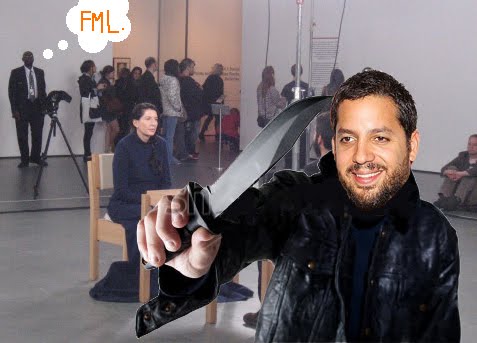
In a cameo way less annoying than James Franco’s but still sort of strange, David Blaine eats some glass with his wine in Abramović’s apartment and suggests an intervention of her performance in which he very publicly and very gruesomely kills her. When she presents this idea to her gallerist, Sean Kelly, he makes a face and is all like “He’s an illusionist. Your work doesn’t have anything to do with illusion; it’s all real.” (Last aside, I swear: Her actually bringing this up to her gallerist was one of my favorite parts; as someone who’s worked as an assistant to many artists, I was giddy at the fact that Akers showed that even the best artists have god awful ideas.)


While I definitely think this documentary is really entertaining and serves as an important record of Abramović’s work, life & practice, it leaves a pretty unsettling feeling in the pit of my stomach, particularly as someone who works in performance. While we are being told by MoMA security, by critics, by those who go to see her, even by herself that she is incredibly vulnerable during The Artist is Present and so much of the focus is on the audience, this naked woman being taken away in tears shows that those statements are just no longer true. It isn’t “all real,” especially if real is talking about this piece with the same language as her older work. Given her age and fame, she will never be able to make the same type of work that she used to, and I mean, that’s fine. It’s really amazing and impressive that she’s still producing, let alone such physically arduous work. I just wonder, with all of her lamentations of being underground for so long, of being called crazy, if this is the price performance art will have to pay for going mainstream. I honestly don’t think that most of it will at all ever, and while it sucks to realize there’s a part of you that’s ok with never having any sort of financial stability via what you love to do, I’m pretty chill with that.

Monday, July 23, 2012

06.11.2012: ALIKA COOPER'S FLAWED BEAUTIES

Brigitte (on couch) (2008)

Maybe this is the wrong place to start, but most paintings of women make me want to punch myself in the face. If you’ve ever read anything I’ve written on this blog, I’m pretty sure my distaste for most representations of females in, like, every media ever is clear, so it should come as no surprise that whenever I see another painting of a woman – especially if she’s naked – I tend to give the painting major side-eye, mutter something about originality and single-notedness under my breath, and walk away. And then there’s Alika Cooper.

Grace (Keith Haring Body Paint) (2010)

"WOMEN/works ON PAPER," curated by Yaoska Davila and up at TENOVERSIX until July 7, is a selection of Cooper’s paintings of famous women, starring the likes of Edie Sedgwick, Grace Jones, Brigitte Bardot, Twiggy, Farrah Fawcett & Little Edie Beale. Not only are these women famous; they’re women whose image literally made them who they are (or are remembered as) today. And that’s where this show just starts to get interesting; all of these paintings are based not solely on the women depicted, but rather on famous photos and stills of these women as depicted by someone else. Whether it’s Grace Jones as painted by Keith Haring as photographed by Tsen Kwong Chi or Brigitte Bardot in a scene from Jean-Luc Godard’s Contempt, this body of work, created between 2007 and 2010, is definitely right on meta-trend.

Edie (grey gardens) (2008)

Edie (ciao manhattan) (2007)

The work definitely doesn’t stop at its meta-ness, however; just saying that these are paintings of pictures of famous women doesn’t at all do justice to the experience of looking at them. Cooper’s style turns these otherwise familiar images on their heads. They’re dirty, they’re gritty, they’re a little confusing. They add new and varied dimensions, sad and beautiful, vulnerable and strong, to the faces and bodies of women we’ve already seen thousands of times. Edie (ciao manhattan) (2007) seems to show a young neanderthal deep in thought. Edie (grey gardens) (2008) could be a painting of Joan of Arc. Adding to this disorientation is the fact that these celebrities are portrayed in goauche on paper with torn, uneven edges. Cooper takes the idea of idealized female celebrity and simultaneously flips it off and caresses it, telling it everything will be ok.

(L to R) Brigitte (large) (2007); Farrah (by Andy) (2008)

I guess in a way these paintings apply the modern lens through which we see young, beautiful female celebrities to their forebearers from a time before Wikipedia and the stalkerazzi. Britney was in a bad place for so long, but now it seems like she’s marrying a nice guy, and that makes me happy. Lindsay! Oh Lindsay. You wanna hate her, but then you remember her parents and understand everything. They’re beautiful, they’re ugly, they’re objects of desire, they’re objects of disgust, which is exactly how I feel while looking at (and sort of being judged by) Brigitte (large) (2007). She’s a little cross eyed and her skin is awful but that hair is so perfect. She’s clearly Brigitte Bardot, but there’s also something very off. Through these paintings we get to see a side of these women that may only exist in Cooper’s head but feels so real you wanna pop open a can of Sofia and drink champagne with them. Out of a can. Cause they actually seem like in this world, they’d be down for that.

Article originally published on the TENOVERSIX blog.

04.16.2012: LACMA’S IN WONDERLAND (OR HOW I LEARNED TO LIKE SURREALISM AGAIN)


I may or may not be partial to Frida Kahlo’s Autorretrato con Collar because the cat in is the spitting image of my handsome black cat, Mung.

I’m a female, Mexican-American artist, so as soon as I heard about "In Wonderland" at LACMA, I emailed my mother and set a date to see it with her. Not only would there be Kahlos (I can’t be the only little girl who grew up simultaneously scared to death of and totally in love with the work of the woman whose image I was as familiar with as Our Lady of Guadalupe), there would be work from Francesca Woodman (every female, teenage art student’s wet dream, amirite?), Maya Deren (My other cat’s name is Glamour Girl, the cat she shared with Alexander Hammid), Louise Bourgeois, Dorothea Tanning, Remedios Varo, Yayoi Kusama, pretty much every badass female artist living and working in the US & Mexico around the same time as dudes were painting melting clocks.


Deren’s Meshes of the Afternoon was the opener of the exhibit. While this was totally sick, what was even sicker was winding through the exhibit and occasionally hearing the soundtrack for it, contributing to the show’s extreme nonlinearness.

While I’m not in love with the name of the exhibit (I don’t necessarily think “grown ass female artist making pretty revolutionary work” when I think Alice), the subtitle, "The Surrealist Adventures of Women Artists in Mexico and The United States," does something that, at least for me, was a pretty big deal from the get-go. For about 2 or 3 years now (because of Black Dahlia Avenger, I admit), the word “Surrealism” has sort of been a dirty word for me. I mean, duh, the work’s great, but those guys were misogynistic d-bags who basically stole an entire movement from their mothers (That may be a stretch, but if anyone can remember the name of the exhibit that showcased the insane photo collages of the mothers of Surrealists, plz let me know). Laaaaame. So in addition to Kahlo & Krew (BEST. GIRL GANG. EVER.) not generally being labeled Surrealists, that whole movement was starting to seem pretty tired and icky to me.


L to R: Duchamp’s Etant Donnes vs. Dorothea Tanning’s Birthday. Which makes you feel better about having a vagina?

But then along came Ilene Susan Fort and Tere Arcq to punch my brain in the face with the biggest “DUH” I never thought of. These women were totally Surrealists, and their work is work that not only I can fall into the rabbit hole of (nyuck nyuck nyuck), but my mom can, too! And Mexicans, and Mexican-Americans, both populations almost never addressed in the fine art world. And that is exactly what makes this exhibition so amazing. It is a collection of Surrealist works that utilize the visual and emotional vernacular of those generally seen as “other,” a group I am firmly planted in, a group that most people I know are firmly planted in, and you know what? It is just as mind-blowing as the work of the Surrealist men. I actually maybe even like most of it better. Snap.


Bridget Tichenor’s Autorretrato. Ugh. Slays me every time.

What most affected me about going to see "In Wonderland" was not the work, for the most part quite influential to me; it was all of these people, a majority of them women, many of them people of color, being so pumped to see the work. The crowd around Las Dos Fridas gave me an anxiety attack I haven’t experienced since the Mona Lisa. In the end, this show is way more than just a celebration of the female Surrealists; it is celebration of all those who look at these works and think “Finally, someone who gets me.”

"In Wonderland: The Surrealist Adventures of Women Artists in Mexico and the United States" is at LACMA until May 6, 2012, when it will be traveling to Quebec and Mexico City.

Article originally published on the TENOVERSIX blog.

01.16.2012: YOUR NEIGHBORHOOD BADASS FEMINIST REBEL NUNS

Pretty OG.

If you’ve ever driven through the intersection of Western and Franklin, you’ve probably noticed the big, white building that is Immaculate Heart High School & Middle School. If you’ve ever driven by around 8 AM or 3 PM, you’ve definitely noticed the onslaught of young girls in uniforms walking to or from the campus (and, possibly, the creepy dudes who lurk around those times). Have you ever, though, looked into its sick, epically feminist history that would lead to the largest group of people leaving the Catholic Church? Here, more or less, is the story.

Full disclosure: I was once a “woman of great heart and right conscience.”

This past October, Anita Caspary, former IH College English Department Chair, Graduate President, President, and of the Immaculate Heart Order/Community, passed away at the age of 95. Before we get to the good stuff, let’s cover a few facts about Caspary: She became a nun in 1936 after receiving her bachelor’s, she got her master’s in English from USC in the early 1940s, and she got her PhD in English at Stanford in 1948. Not only was she one of the few women pursuing a doctorate in the 1940s, but she wore a habit on campus, which she felt, as written in her memoir, created both “a distance and mystery.” So yeah, she was already pretty amazing and had probably dealt with enough misogyny to make your head spin by the time she was elected to lead the Immaculate Heart Order in 1963.

Anita Caspary (second from right) meeting with Parisian designer Jean Louis to discuss new habit designs. Yeah. Our type of lady.

It was around this time that Vatican II was happening, and the Catholic Church was basically trying to “let in some fresh air,” as Pope John XXIII put it. The Sisters of the Immaculate Heart of Mary, with Caspary at the lead, were all for it, so they made a few changes to how they ran things, the most escandaloso of which were not wearing their habits all of the time (I mean come on, it’s LA. That must get so hot.) and praying whenever they want instead of at fixed times throughout the day. Unfortunately, this didn’t sit too well with ultra-conservative Cardinal James Francis McIntyre, Archbishop of LA at the time, who banned them from teaching in any Catholic schools in whatever the Catholic school equivalent of LAUSD is.

Whether in a habit or sweater set, this woman knew how to shake things up in the best way possible.

The sisters went all the way to the Vatican to try to appeal his ruling, because all they really wanted to do was teach and help people…while, yknow, being able to make decisions about what they put on their bodies and what they did with their time, like adults are generally able to do. The Vatican didn’t help them out, so 300+ nuns from the order made the very difficult decision to be released from their vows. In a Time Magazine interview, Caspary simply said “I wondered how much energy you could spend fighting authority when you could spend that same energy doing what you should be doing.”

So instead of fighting The Man (The Men? Quite literally.), Caspary and the other nuns started the Immaculate Heart Community. The Community would continue to run Immaculate Heart High School and College (until its close in the 80s – It occupied what is now AFI.) and its various organizations dedicated to education, helping the disenfranchised, environmental activism, and pretty much anything else that you’re pretty into unless you’re an awful person.

One of Corita’s sick-yet-posi prints.

Caspary even taught a class on Feminist Spirituality at Immaculate Heart College. So cool. Aaaand, in case you needed any more proof of these ladies’ awesomeness, the most famous member of the Community is Corita Kent, an artist-nun best known for her screen prints and stamp design. (My personal favorite hung in my mom’s office and read something along the lines of “I never would like to have lived without offending someone.”) About Caspary, she told Time “She is a quiet leader, perfect for the age of Aquarius, when, you know, there are no big heads.” The perfect leader for the age of Aquarius. Ballin’.

Article originally published on the TENOVERSIX blog.

12.18.2011: IF I WAS


There have certainly been a shit ton of great rebuttals to Gene Marks' Forbes.com article, "If I Was A Poor Black Kid" (The full text can be found after the cut if you haven't read it; this dude gets money for hits, and yeah, fuck that.), including Becky Sharper's "Uncle Whitey Explains it All," Ta-Nehisi Coates' "A Muscular Empathy," Kelly Virella's "If I Were The Middle Class White Guy Gene Marks," and DNLee's "If I were a wealthy white suburbanite." While these articles, especially in unison, are a solid amassing of my personal sentiment towards Marks' incredibly insightful and never-before-thought-of solution to class discrimination and racism, there are a few issues I have with his article that haven't really come up.


First of all, if you haven't read it, this guy is the poster child for rich, white privilege and not understanding why there aren't more people of color who are rich, privileged and blogging for Forbes like him. Poor kids just, like, need to work harder, duh. If he was poor, he wouldn't care if he was..poor..or went to one of the worst schools in America (or didn't have food on the table or had to work a shit job to support his family or had parents who, for whatever reason, couldn't always be there for him, simultaneously making sure he works hard and cheering him on); he would just work hard and everything would be super. Also, he would Google n shit. On his computer. With internet. If he wanted to go to a better school, he would just show up to this school (that he Googled), and upon finally receiving a candidate that makes them look like proponents of diversity, the admissions committee would give him a free ride. Then he's set 4life, cuz yknow, when you show up looking like a poor kid (or just not wearing YSL and not fucking starving yourself), your peers think you're super cool and never mock you. But still, if that happened, he would just continue to work hard; success that he may have never actually seen someone achieve is all that matters to his somehow superhuman teenage self. Oh yeah, also, computers.


I mean this sort of thinking is really nothing new, right? Yeah, yeah, poor people just need to work hard. If this was true, my Mexican grandmother who cleaned houses and took care of other people's children for a living would be the head of the motherfucking Illuminati. Poor people work just as hard as (if not usually harder than, depending on various circumstances) rich people, but yknow, that's also a ridiculous generalization. Some poor people don't like working. Some poor people aren't the brightest. As it turns out, the same rules that apply to the personality types and IQ of rich people apply to those of poor people. People are just people, and very few people are magical enough to completely alter the seemingly clear course of their lives. I mean shit, if your life really has been a struggle since the day you were born, maybe you're a little depressed, right? But you're probably not going to get to a therapist at 10, and if you continue to be poor throughout your life, you're probably not going to get the medication that could actually help you. Cord Jefferson tells a heart-breaking story about a kid who would go apeshit in class so he could be sent home to prevent his mother from working as a prostitute. Obviously that's an extreme, but if you can't understand how working harder isn't a solution to a lot of the issues facing poor children, let alone poor humans, your as stupid as Marks keeps on calling his children.


Clearly, this article contains a lot of false truths and holes in the understanding of being human, let alone being poor, but what really burns my biscuits is a paragraph towards the end:

Because a poor black kid who gets good grades, has a part time job and becomes proficient with a technical skill will go to college. There is financial aid available. There are programs available. And no matter what he or she majors in that person will have opportunities. They will find jobs in a country of business owners like me who are starved for smart, skilled people. They will succeed.

... Exsqueeze me? Australia just read that and was like "WTF, mate?" This Gene Marks character wants the brightest of the brightest, kids so focused and smart and excited about learning that they were able to rise above insane difficulties in their lives and end up at the same universities as those "future heads of state" types, to become proficient at a technical skill and proceed to work for assholes like him, who will not only surely talk down to them, but also write like they're 2nd graders? (Srsly though, someone telling a group of people they need to work harder and go to school when he writes like Marks would be totally lulzable were the message not so disconcerting.) Is one of those technical skills not being a dumbass? Is Marks confusing Harvard with ITT Tech? Or, more disturbingly, does he actually believe that either (a) the best a poor person can do, despite almost superhuman focus and incredible intelligence, is work for someone else or (b) the only thing poor children dream of (or should dream of) is finally attaining admittance into the (ever-fading) middle class? At best, this is one step above Gingrich's janitor plan. At worst, this is some crazy ass racist and classist shit.


(I hate this phrase but) Especially in this economy, it is incredibly irresponsible of Marks to try to tell whoever the fuck he thinks he's talking to that the sure bet to money is higher education. This may come as a surprise, but free money to go to school is hard to get. Even with a decent amount of resources and the magic of the Google, it can be hard to find and really time-consuming to apply for. If this black kid (Pardon - black, male kid; if Marks is trying to talk about both sexes, especially in the tech world, there is a whole other list of obstacles to surmount that need to be discussed) has a part-time job while going to school, where he is excelling, and managing to gain some sort of technical proficiency somewhere along the line, how the fuck is he going to have extra time to apply to scholarships? Most don't cover everything, so I'm assuming this unicorn child is going to have to apply for a few and get them all. Only then will he not graduate with a significant amount of debt, which likely won't be covered by the likely exploitative job Marks has set up for him. Across the board, schools are more expensive than they've ever been and my generation is going to be "the first to not surpass the living standards of [our] parents' generation." Yeah, that time your mom or dad made you feel like the one in the family who "doesn't work hard enough" cause you work a shitty retail job and have no money despite having a degree from NYU, that's bullshit. So I'm pretty sure that makes it bullshit cubed coming from a rich, white dude to poor, black children.


But that whole last paragraph was a digression from my main point: just as poor people are people, too, poor people have dreams beyond the now quite ridiculous notion of social mobility, too. If Marks is actually concerned with improving the disparities he claims to be aware of and so fucking into education, why isn't he talking about this black kid getting his MA, his PhD, his teaching certification, and going back to his community to help out future poor, black kids (or to teach them how to use Google Scholar)? Why is he limiting the options of this group of kids he's purportedly trying to help? ...to work for him. Can these kids not find their calling on their own, based on what they love? Last I checked, people don't succeed and excel due to the dream of a boring tech job. Steve Jobs may have been good with computers, but I'm pretty sure that's not what made him Steve Fucking Jobs (Little known fact: That's his actual real name). Louis CK believes that the underdog can be the next Steve Jobs. Why can't you, Gene Marks?

All images from www.ifiwasapoorblackkid.com.

12.02.2011: COASTING GOES TO SPACE, AND IT’S, LIKE, TOTALLY AWESOME


While Coasting is comprised of Fiona Campbell and Madison Farmer, currently residing in Portland, Oregon and Memphis, Tennessee, respectively, this hilarious and amazing video is from LA native and current resident, Sarah Manuwal. Fresh out of CalArts’ Experimental Animation graduate program, Manuwal utilized the video for Portland, a song very much about place, with lyrics like “Won’t you stay” and “Where should we go,” to create the poster-universe for my generation.

In the video, Campbell and Farmer, as their clay-mationed counterparts, are just chillin in a bedroom pretty much perfect for a fashionable lady raver gnome (I WILL make this a meme!), drinkin beer and listenin to records. They put on their record and are instantly transported to probably the best performance of their lives on a sparkly crystal planet with pizza back up singers that put the California Raisins to shame with their frosted lip glamour. They leave Earth on their matching (duh, BFFs always match) skateboards to travel through space, where hot dogs and cheezburgers can be has’d as they rain down like comets …and Laura Palmer IS ALIVE, driving around in a sweet red convertible. (Perhaps this is how the red room exists in outer space? Maybe she isn’t truly free?! Oh no.) Anyway, she meets up with Coasting and gives them crowns that match hers! Now they’re all BFFs/beauty queens! Best space adventure ever.

Article originally published on the TENOVERSIX blog.